

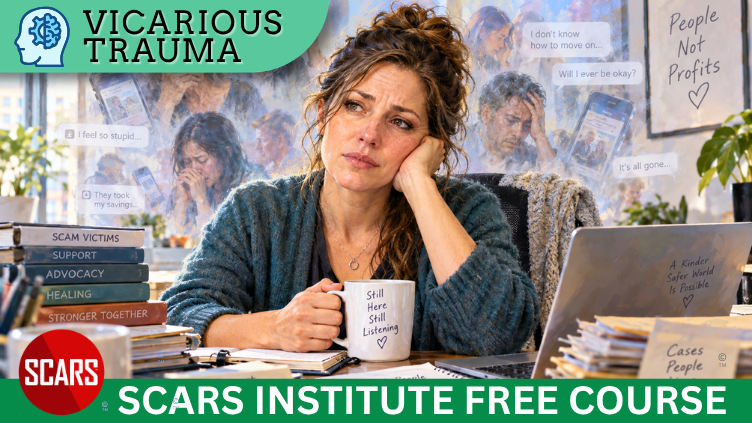

Understanding and Addressing Vicarious Trauma
A Course for Victim Advocates, Volunteers, and Nonprofit Staff
Supporting people who have been harmed by crime is meaningful work, and it carries a cost that is rarely named out loud. Repeated exposure to other people’s trauma changes the people who do this work. That change is not a weakness, a character flaw, or a sign of being unsuited to the role. It is an expected occupational condition called vicarious trauma, and because it is expected, it can be recognized, prevented, and addressed.
This course teaches advocates, volunteers, and nonprofit staff what vicarious trauma is, how to recognize it in themselves and in the people they work alongside, what protects against it, and how an organization can build a culture that shares responsibility for staff wellbeing rather than leaving each person to survive it alone. It is written for people who support crime victims of every kind, including the scam-crime victims served by the SCARS Institute, whose advocates absorb accounts of devastating financial loss, betrayal, profound shame, and suicidal despair, often while supporting people the wider world has wrongly blamed for their own victimization.
The knowledge base for this course is adapted by the SCARS Institute from the Vicarious Trauma Toolkit (VTT), created by the United States Department of Justice, Office for Victims of Crime (OVC). SCARS gratefully credits the OVC for developing that public resource. This course is an original educational adaptation written for the SCARS community; it is not endorsed by, and does not officially represent, the OVC or the Department of Justice. The original toolkit is available at ovc.ojp.gov.
A note on scope. This course is education, not therapy, and it does not diagnose or treat any condition. It gives you a framework and practical tools. Anyone experiencing serious or persistent distress should seek qualified professional support, and this course will point to when and how to do that.
How to take this course. Move through it at your own pace. Each lesson stands on its own but builds on the ones before it. Each ends with a short quiz to consolidate what you have learned. There is no penalty for revisiting a lesson, and returning to material is a normal part of learning it.
Course Syllabus and Lessons
What Vicarious Trauma Is
Recognizing Vicarious Trauma
Protecting Yourself: Individual Strategies
The Organization’s Responsibility
Building A Trauma-Informed Organization
Enroll Here
Free Instant Access
How This Works
- First, REGISTER with our Course System
- Second, ENROLL in our Free Courses Membership
- Third, ENROLL in the course that interests you. Look at our Course Catalog to select
- Use the course by visiting the lessons, one by one
- See your account and course progress in Your Dashboard
- Learn, enjoy, and heal and recover